 Editorial illustration
What was behind the ground stop?
The government’s initial explanation for the November 13 ground stop centers on a cable replacement at one remote facility. Why was a local intervention followed by radio and radar problems at 17 of 22 en route centers?
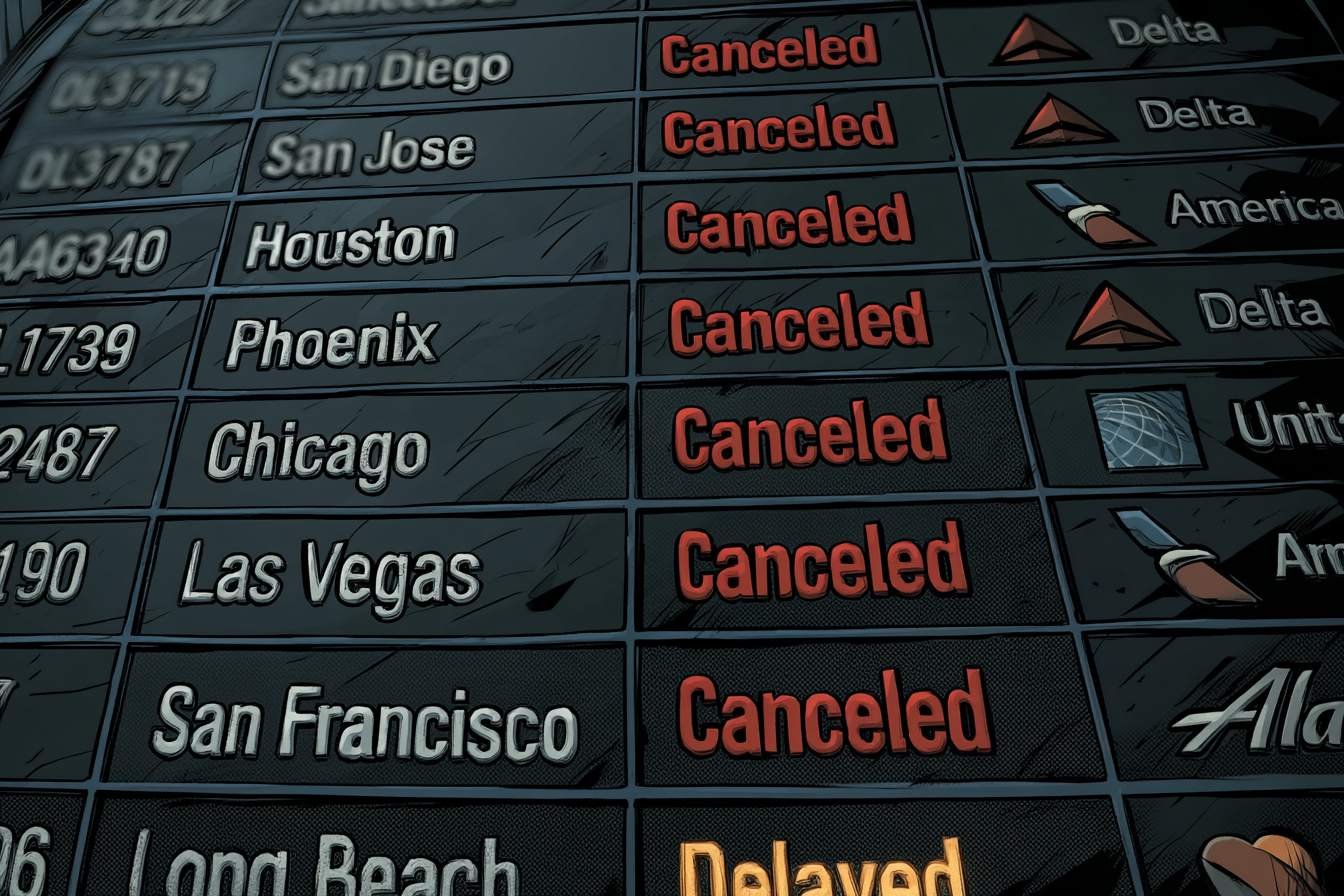
From November 13 to 15, U.S. airports felt the effects of what the Associated Press called the longest nationwide ground stop since 2001. How did the failure spread? Which safeguards were supposed to stop it? Who chose the maintenance window?
Associated Press · FAA · BBC
Simultaneous failures and the domino effect
Controllers interviewed by The Atlantic questioned how facilities across the country could lose frequencies at the same time when the network has digital and analog redundancies.
The FAA’s count shows the scale. The controllers’ question goes to the origin: what did those centers share that allowed the disruptions to spread?
FAA · The Atlantic
Why work on the network during active operations?
Sean Duffy traced the onset to L3Harris replacing copper wiring with fiber at a remote Arkansas site. In the account given, a router reportedly sent more than a thousand connection attempts every few seconds. Instability also reached a facility in Texas.
Why was the work done during busy daytime operations, and what safeguards were supposed to isolate the site before the problem spread?
Associated Press · Los Angeles Times · BBC
Three days between the SMART rollout and the failure
On November 10, three days before the ground stop, the FAA announced the nationwide expansion of SMART, an AI-based traffic management support tool developed by Air Space Intelligence.
The timing makes it worth examining what changed across the network that week and what integration testing was done.
FAA · Associated Press
The SMART denial leaves a question
The Trump administration and the developer denied that SMART caused the failure. The FAA says the tool aggregates data and does not feed the control systems.
The administration initially described new technology overloading old equipment. Which technology, and which equipment? The technical question is about compatibility between the changes being rolled out and the infrastructure already in use.
FAA · Associated Press
Floppy disks in critical infrastructure
The FAA is still replacing four systems from the 1980s used at more than 400 facilities, including equipment that relies on floppy disks. It plans to install the replacement at 435 sites by the end of 2028.
Old and new systems coexist during the transition. The outage puts a spotlight on the risks modernization has to manage while the network remains in service.
FAA · Associated Press · Associated Press
Who takes responsibility?
Congress approved US$12.5 billion to modernize air traffic control. The White House is seeking another US$30 billion. Duffy pointed to underinvestment by previous administrations and to L3Harris’s maintenance work.
The funding fight is unfolding alongside the dispute over responsibility. Who authorized the work, who supervised it, and what contingency plans were in place?
FAA · Associated Press · Associated Press
The cybersecurity warning came first
The GAO had identified shortcomings in the management of cybersecurity risks to aviation communications and recommended steps for the FAA. The Department of Homeland Security said it found no signs of a cyberattack or foreign sabotage.
Which recommendations had already been implemented, and what evidence supported the government’s assessment of the cyberattack hypothesis?
GAO · Associated Press
The coincidences that fueled suspicion
Reports of internet and communications disruptions at the U.S. National Weather Service circulated around the time of the aviation failure, a day after Microsoft service outages and weeks after false bomb threats disrupted flights in Europe.
The timing fueled speculation about outside interference. Federal officials and Microsoft said they found no link between the company’s outage and the ground stop. A common cause for the incidents remains unproven.
CNN Portugal · The Atlantic · Associated Press
Who bears the cost?
Al Jazeera cited more than 4,700 cancellations and about 10,000 delays on Friday. A later FlightAware tally cited by ABC News put Friday cancellations above 9,000.
U.S. passengers are not automatically owed compensation for the air traffic control disruption. Those whose airline cancels their flight and who choose not to travel or accept an alternative are entitled to a refund. At Brazilian airports, ANAC rules provide assistance based on the wait and free rebooking in qualifying cases.
Al Jazeera · ABC News · DOT · ANAC